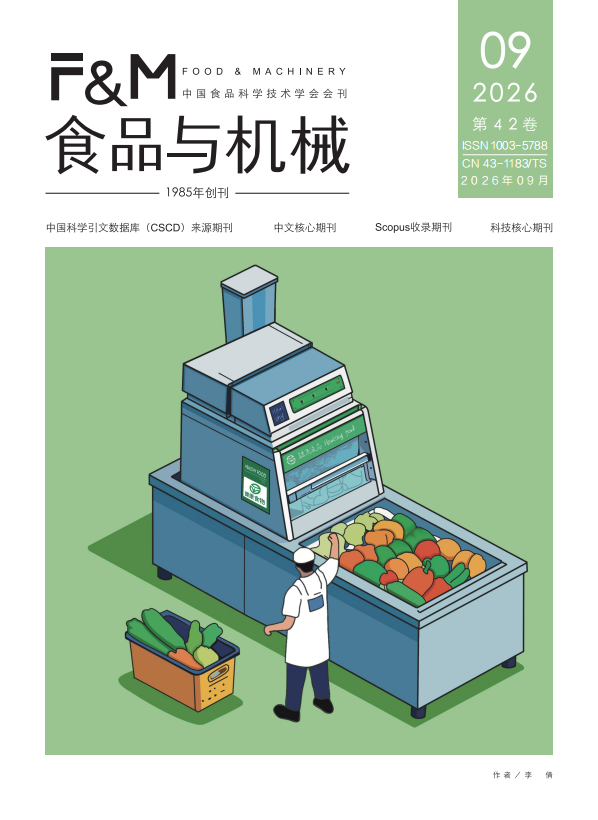
Food and Machinery (shipin yu jixie) is an open access scholarly journal which comprehensively reports the up-to date progress of research and development of food science, technology, packaging material and machine. It has been indexed by various databases such as the Scopus, CSCD, DOAJ, CAB Abstracts, Global Health, CA, EBSCO, Ulrichsweb, FSTA, JSTChina, OAJ, EuroPub, ICI World of Journals, J-Gate, WJCI, Core Journals of Peking University, CSTPCD, RCCSE, COAJ, AgriSCI+, Web of Agriculture, CNKI, Wanfang Data, etc. At the same time, this journal has been selected as a cluster-based pilot project journal under the China Science and Technology Journal Excellence Action Plan, as well as a journal participating in the construction project for cultivating world-class Hunan-style science and technology journals in Hunan Province. In addition, as the official journal of the Chinese Institute of Food Science and Technology (CIFST), this publication is the only engineering journal in China that focuses on interdisciplinary fields of food science and equipment, with distinct engineering characteristics.
Current Issue: Volume 42, Issue 9 (2026)
Fundamental Research
Preparation of Gleditsia sinensis polysaccharide microemulsion and their hydrophobic interactions with quercetin
Xu Chenrui, Yao Qiuping, and Deng Shenghui
Date posted: 10-21-2026
DOI: https://doi.org/10.13652/j.spjx.1003.5788.2025.80871
[Objective] To investigate the formulation process of Gleditsia sinensis polysaccharide microemulsion and the hydrophobic interactions between the microemulsion and quercetin. [Methods] A pseudo -ternary phase diagram was drawn through compatibility experiments to optimize the formulation of the G.sinensis polysaccharide microemulsion. Based on the pyrene fluorescence probe technique, the effect of quercetin concentration on the I 1/I3 value in the microemulsion was examined to explore the hydrophobic and polar interactions between quercetin and the carrier in the G.sinensis polysaccharide microemulsion system. [Results] The prepared G.sinensis polysaccharide microemulsion was of the oil -in-water (O/W type ). The optimal formulation consisted of 35.4% Tween 80-Span 80 (mass ratio 3∶2), 17.7% anhydrous ethanol, 13.3% liquid paraffin, and 33.6% G.sinensis polysaccharide solution (5 mg/mL ). After ultrasonic treatment for 10 min, the resulting microemulsion exhibited a smaller particle size and a larger absolute ζ-potential, indicating better stability. Within a certain range of quercetin concentrations, longer ultrasonic treatment led to a lower relative molecular mass of the G.sinensis polysaccharide and decreased sensitivity of the I 1/I3 value of the microemulsion. [Conclusion] The preparation process of the O/W microemulsion using G.sinensis polysaccharide is simple. The microemulsion formed from low -relative -molecular -mass G.sinensis polysaccharide obtained via ultrasonic treatment significantly suppresses the sensitivity of hydrophobic interactions to quercetin concentration, which is beneficial for achieving stable and controlled release of quercetin in the gastrointestinal environment.
Screening and identification of a Vibrio parahaemolyticus -antagonistic fusion Weissella confusa Y10-1 and evaluation of its bacteriostatic activity
Yuan Baolong, Yi Han, Shen Naikun, Liang Ying, Tang Jiahao, Zhang Hongyan, and Zhang Bin
Date posted: 10-21-2026
DOI: https://doi.org/10.13652/j.spjx.1003.5788.2025.80863
[Objective] To isolate and screen lactic acid bacteria from the intestinal tract of marine fish with inhibitory activity against Vibrio parahaemolyticus and to investigate their antibacterial activity. [Methods] Using V.parahaemolyticus as the indicator bacterium, preliminary antibacterial screening was performed. The strain was identified through morphological, physiological, and biochemical characteristics as well as 16S rRNA gene sequence analysis. The antibacterial spectrum of the strain was determined, and the antibacterial stability, antibacterial mechanisms, and minimum inhibitory concentration (MIC ) of its cell -free supernatant (CFS ) were analyzed. [Results] A strain, Y10-1, showing strong antagonistic activity against V.parahaemolyticus was screened and identified as Weissella |confusa. The antibacterial substances produced by this strain demonstrated broad -spectrum antibacterial activity, were heat resistant (100 ℃ for 15 min ), and exhibits inhibitory activity against V.parahaemolyticus within a pH range of 2.0~9.0. The MIC against V.parahaemolyticus was 5%. Under the condition of 3×MIC, the antagonistic effect against V.parahaemolyticus was the most pronounced. [Conclusion] The strain Y 10-1 screened in this study exhibits good antagonistic activity against V.parahaemolyticus and has considerable potential for development and application in food preservation.
Effects of microwave decocting on release law of flavor substances in cod soup
Zhang Chaomin, Li Xinxi, Feng Jianhui, and Xu Yongxia
Date posted: 10-21-2026
DOI: https://doi.org/10.13652/j.spjx.1003.5788.2025.80987
[Objective] To prepare cod soup using cod as the main raw material by microwave heating, with traditional boiling as the control, and to compare and analyze the effects of microwave decocting on the release law of flavor substances in cod soup. [Methods] Cod soup was processed at different durations (15,30,45, and 60 min ), followed by sensory evaluation. The changes in the contents of trichloroacetic acid (TCA )-soluble peptides, amino acid nitrogen, flavor nucleotides, organic acids, inorganic salt ions, and free amino acids in the soup were analyzed. [Results] The contents of TCA -soluble peptides, amino acid nitrogen, flavor nucleotides, organic acids, and inorganic salt ions (Na+, K+, PO3-4, and Cl-) all increased with the extension of decocting time, and were significantly higher in the microwave decocting group at 60 min than in the traditionally boiled group at 60 min (P<0.05). The sensory score, total flavor nucleotides, total organic acids, and total free amino acids all reached their highest values at 60 min of microwave decocting. The electronic nose and electronic tongue effectively distinguished the soups prepared by the two boiling methods. A total of 80 volatile compounds were identified by GC -MS, among which aldehydes, esters, and ketones were the main contributors to flavor differences. Microwave heating promoted the formation of aromatic aldehydes, ketones, esters, and some alcohols. [Conclusion] Microwave decocting is more conducive to the increase of taste compounds and volatile flavor substances in cod soup, and makes a significant contribution to the overall flavor profile of the soup.
Differential analysis of volatile components between the flesh and peel of Poria cocos based on dynamic headspace-GC-MS
Meng Xue, Xu Hui, Li Huixin, and Cheng Chuanyun
Date posted: 10-21-2026
DOI: https://doi.org/10.13652/j.spjx.1003.5788.2025.80687
[Objective] To compare the differences in volatile components between Poria cocos flesh and peel using dynamic headspace -gas chromatography -mass spectrometry (GC-MS). [Methods] Fresh P.cocos was used as the test sample. Volatile components were enriched by dynamic headspace adsorption, and the differences in volatile components between the flesh and peel were analyzed by GC -MS. Principal component analysis and cluster analysis were used to identify the main active components responsible for these differences. [Results] A total of 110 volatile compounds were detected from the peel and flesh of P.cocos, including 27 unique components in the flesh and 28 unique components in the peel. The volatile compounds with relatively high percentage contents in the flesh were mainly alkenes and alcohols, whereas those in the peel were mainly alkenes. The results of principal component analysis and cluster analysis indicated that alkenes and alcohols were the main components affecting the differences between the peel and flesh. [Conclusion] In traditional applications, P.cocos flesh and peel exhibit the effects of "strengthening the spleen and calming the heart" and "promoting diuresis and reducing swelling", respectively.
Safety & Inspection
Preparation and certification of matrix reference material for zearalenone in whole wheat flour
Zhang Bing, Ye Jin, Li Peng, Wu Yu, Li Li, Dong Zemin, Wan Wengen, and Wang Songxue
Date posted: 10-21-2026
DOI: https://doi.org/10.13652/j.spjx.1003.5788.2025.80780
[Objective] To expand the varieties of matrix reference materials, improve the concentration levels of quantitative values, and meet the needs of market detection and scientific research, a matrix reference material for the compositional analysis of zearalenone (ZEN ) in whole wheat flour was developed. [Methods] Naturally contaminated wheat was used as the raw material, and the matrix reference material was prepared through cleaning, milling, and homogenization processes. It was vacuum -packed in aluminum foil pouches and sterilized by irradiation. The effects of grinding particle size and mixing time on the homogeneity of ZEN were investigated. Value assignment was conducted using two methods with different principles:ultra -high performance liquid chromatography (UPLC ) and stable isotope dilution liquid chromatography -tandem mass spectrometry (LC-MS/MS ), and was validated through a collaborative study involving seven laboratories. [Results] The optimal grinding particle size is determined to be 380 μm, with a mixing time of 32 h. The homogeneity test (F-test) and stability studies demonstrate that the reference material remains stable for 7 d at 60 ℃ and for 17 months under light -protected conditions at (20±5) ℃. The ultimate certified value of ZEN in whole wheat flour is determined to be (57.1±6.0) μg/kg (k=2,95% confidence interval ). [Conclusion] The reference material supplements and improves the matrix reference material system at the limit of mass fraction (60 μg/kg ) and can support laboratory method validation, quality control management, and skill assessment of inspectors.
Measurement uncertainty assessment for total aerobic bacterial count and coliforms in cooked foods according to RB/T 228
Liu Weiping, Wan Jianchun, Han Ying, Jiang Pengfei, and Li Shixiang
Date posted: 10-21-2026
DOI: https://doi.org/10.13652/j.spjx.1003.5788.2025.80729
[Objective] To evaluate the measurement uncertainty in the determination of total plate count and coliform bacteria in cooked foods, thereby improving the accuracy of test results. [Methods] The plate counting methods specified in GB 4789.2—2022 and GB 4789.3—2025 were employed to detect 18 cooked food samples under two conditions (A and B ). The combined standard uncertainty (uc(y)) and expanded uncertainty (U=2×uc(y)) were calculated in accordance with RB/T 228—2023. [Results] Based on intralaboratory reproducibility, the uc(y) for total plate count determination was 0.030 3 (U=0.060 6), and that for coliform bacteria determination was 0.179 7 (U=0.359 7). When all uncertainty components were considered, the uc(y) for total plate count determination of Sample 1 under Condition A increased to 0.109 4 (U=0.218 8), and that for coliform bacteria determination increased to 0.242 4 (U=0.484 8). [Conclusion] The primary factors affecting the measurement uncertainty of this method include technical uncertainty, matrix uncertainty, and distribution uncertainty. The application of RB/T 228—2023 for uncertainty assessment can improve the accuracy of test results.
Magnetic surface molecularly imprinted polymers for the extraction and analysis of tetracycline residues from fish meat
Ye Run, Zhao Lei, Li Yuanxin, Cai Jing, Sun Wei, Chen Qiong, and Zhang Wenqian
Date posted: 10-21-2026
DOI: https://doi.org/10.13652/j.spjx.1003.5788.2025.80941
[Objective] This study aims to prepare magnetic surface molecularly imprinted polymers (MMIPs ) via a sol -gel method using tetracycline (TC) as the template molecule, and to combine them with spectrophotometry for the enrichment and detection of TC residues in fish meat. [Methods] Activated carbon (LAC ) is prepared from Magnolia grandiflora seeds using 60% (w/w) phosphoric acid solution as the activator. Magnetic activated carbon (MLAC ) is then obtained by co -precipitation -based magnetization of LAC. Using MLAC as the carrier and TC as the template molecule, MMIPs are synthesized, and their adsorption performance toward TC is investigated. The resulting materials are characterized by SEM, EDS, BET, and FTIR. After enrichment and separation by MMIPs, TC in fish meat is determined by spectrophotometry. [Results] At 298 K in a 600 mg/L TC solution, the MMIPs exhibit a maximum imprinting factor of 1.92, with an adsorption capacity of 108.18 mg/g. After six consecutive reuse cycles, the adsorption capacity of MMIPs remains at 76.46 mg/g, still reaching 69.23% of the initial adsorption capacity. The MMIPs also demonstrate strong adsorption selectivity toward substances with a fused tetracyclic ring structure. The adsorption of TC onto MMIPs follows pseudo -first-order kinetics and conforms to the Langmuir isotherm model, with an apparent constant n>1, indicating monolayer adsorption on a homogeneous solid surface. The thermodynamic parameter shows ΔH>0, suggesting that the adsorption is endothermic and favored at higher temperatures;ΔS>0, indicating an increase in system disorder;and ΔG<0, confirming that the adsorption process is spontaneous. At spiked concentration levels of 10~60 μg/mL, the recoveries range from 81.87% to 91.13%, with RSD values between 2.55% and 3.16%, demonstrating successful enrichment and detection of TC in fish meat. [Conclusion] The prepared MMIPs exhibit high adsorption capacity, good selectivity, and promising potential for practical applications.
Geographical origin tracing of soybeans using electronic tongue and electronic eye combined with multi-level information fusion based on Informer-Swin Transformer
Li Xin, Wang Zhiqiang, Han Tianrui, and Xu Suchao
Date posted: 10-21-2026
DOI: https://doi.org/10.13652/j.spjx.1003.5788.2025.81005
[Objective] To achieve rapid traceability detection of soybeans from different geographical origins. [Methods] A novel method for rapid soybean origin traceability is proposed based on the fusion of information from electronic tongue and electronic eye. The electronic tongue and electronic eye are used to collect taste fingerprint and visual image information, respectively, from soybeans of different origins. To address the differences between the temporal sequence features of electronic tongue signals and the spatial image features of electronic eye data, Informer and Swin Transformer are respectively employed to extract key features from the two types of data. A dual -modal feature interaction module is designed to perform deep interaction between the two types of features, thereby obtaining multi -scale inter -layer mutual information. A cross -attention fusion module is then applied to integrate the inter -layer mutual information, enabling efficient cross -modal information fusion and classification recognition. [Results] The proposed model has good discriminative ability for soybeans from different origins, achieving an accuracy of 98.33%, precision of 98.34%, recall of 98.33%, and F1-Score of 0.983 3. [Conclusion] This method provides an efficient and reliable new approach for the rapid traceability detection of soybean geographical origin.
Rapid detection of tomato nutritional components based on NIRS and PSO-LightGBM
Shi Lichun, Wang Songwei, and Wang Zhizhong
Date posted: 10-21-2026
DOI: https://doi.org/10.13652/j.spjx.1003.5788.2026.60065
[Objective] To achieve rapid, non -destructive, and high -precision detection of six nutritional components in tomatoes, including dry matter, soluble sugar, total acid, vitamin C, soluble solids, and lycopene. [Methods] A tomato nutritional component detection model based on near -infrared spectroscopy (NIRS ) combined with light gradient boosting machine (LightGBM ) optimized using the particle swarm optimization (PSO ) algorithm (PSO -LightGBM ) was proposed. Using the six nutritional components as detection indicators, near -infrared spectral data (scanning range:400~2 500 nm) were collected from 471 tomato samples. Seven preprocessing methods were compared, and the optimal combination of standard normal variate (SNV ) transformation and first derivative was selected to eliminate noise and baseline drift. The PSO algorithm was used to optimize the key hyperparameters of LightGBM (number of leaves, learning rate, tree depth, feature sampling ratio, and Bagging ratio ) to construct a synchronous multi -component prediction model. Meanwhile, partial least squares regression (PLSR ), unoptimized LightGBM, and grid search -optimized LightGBM (GS-LightGBM ) models were established as comparison models. [Results] The PSO -LightGBM model achieved the highest prediction accuracy for all six nutritional components. The coefficients of determination for the prediction set (R2p) for dry matter and soluble solids reached 0.987 and 0.973, respectively, with residual prediction |deviation (ERPDp) values of 6.732 and 5.115, respectively. The R2p values for total acid, soluble sugar, and vitamin C all exceeded 0.95, and their ERPDp values were all greater than 2.5. The R2p for lycopene increased to 0.956, representing a 12.4% increase compared with that of the unoptimized LightGBM model. The prediction -set root mean square error (ERMSEP ) of PSO -LightGBM was, on average, 34.7% lower than that of PLSR and 15.2% lower than that of GS -LightGBM. [Conclusion] This method addresses the insufficient generalization ability caused by the random setting of LightGBM parameters and enables synchronous and accurate detection of multiple nutritional components in tomatoes.
Food Equipment & Intelligent Manufacturing
A non-destructive appearance quality detection method for primary-processed crayfish based on improved YOLOv 11
Wang Xujia, Wang Shuqing, and Hu Haoyu
Date posted: 10-21-2026
DOI: https://doi.org/10.13652/j.spjx.1003.5788.2025.81065
[Objective] To achieve rapid and non -destructive online detection of the appearance quality of crayfish during primary processing and to improve detection accuracy and real -time performance in complex scenarios. [Methods] A dataset for crayfish appearance quality is constructed for complex scenarios on primary -processing production lines, and a crayfish appearance quality detection algorithm YOLO -CQ based on YOLOv 11n is proposed. DualConv is introduced to improve the C 3k2 module, enhancing the model's feature extraction capability while optimizing the allocation of computational resources. Deformable attention (DAT ) is integrated into the C 2PSA module, enabling the model to adaptively focus on key regions. In addition, an IoU -based dynamically weighted SlideLoss is adopted to optimize the classification loss, thereby balancing the gradient contributions of samples with different difficulty levels during training. [Results] YOLO -CQ achieves the precision of 86.6%, the recall of 84.3%, and the mAP@ 0.5 of 91.3%, which represent improvements of 2.5%, 2.3%, and 3.4% over those of YOLOv 11n, respectively. YOLO -CQ reaches an inference speed of 211.5 FPS. [Conclusion] YOLO -CQ significantly improves the detection accuracy of crayfish appearance quality while maintaining model lightness and real -time performance, meeting the requirements of online grading on primary -processing production lines.
Design and experimental study on drying performance of a belt-type gas jet impingement dryer
Liu Xinhan, Ju Haoyu, Zhang Weipeng, Geng Yahui, Miao Huan, and Hou Liyuan
Date posted: 10-21-2026
DOI: https://doi.org/10.13652/j.spjx.1003.5788.2025.81215
[Objective] To address the issues of uneven product quality, limited loading capacity, and the inability to achieve continuous drying in existing gas jet impingement dryers, a novel belt -type gas jet impingement dryer is designed to enhance the practicality and drying performance of the equipment. [Methods] The belt -type gas jet impingement dryer mainly consists of an airflow distribution chamber, a drying chamber, a centrifugal fan, a temperature control system, and a transmission system. The conveyor belt speed, airflow temperature, and air velocity can be adjusted according to the different materials. Simulations are conducted using Fluent software for airflow distribution chambers with different nozzle diameters and with the addition of flow -equalizing plates of varying grid sizes. Drying performance experiments are carried out using potato slices as the material, and the results are compared with those of conventional hot air drying equipment. [Results] A nozzle diameter of 20 mm achieves superior performance in airflow distribution. After incorporating a flow -equalizing plate into the airflow distribution chamber, the plate with an 8 mm ×680 mm grid size yields the best results, reducing the velocity non -uniformity coefficient from 34.74% to 8.54% and the maximum velocity deviation ratio from 36.08% to 15.45%. Compared with a hot air dryer, the belt -type gas jet impingement dryer shortens the drying time by 42.51%, increases the drying rate by 254%, and significantly improves the drying efficiency. [Conclusion] The belt -type gas jet impingement dryer can significantly improve drying |uniformity and efficiency.
Storage Transportation & Preservation
Effects and mechanisms of electrostatic field-assisted temperature rising on inhibiting color browning of modified atmosphere-packaged lamb ribs during 10 ℃ storage
Huang Zhiji, Wang Rong, Chen Bingyan, Zhu Lewei, Li Xinwei, Lin Yiqin, Lin Lijuan, Liu Yun, Lin Xiaozi, and Li Weixin
Date posted: 10-21-2026
DOI: https://doi.org/10.13652/j.spjx.1003.5788.2025.80879
[Objective] To address the problem of browning and oxidation in meat products processed from frozen lamb during shelf life. [Methods] Frozen sliced lamb ribs during temperature elevation were treated with an electrostatic field and then packaged using modified atmosphere packaging with different gas compositions. The samples were stored at 10 ℃ after packaging, and meat color, total viable count, oxidation level, and antioxidant enzyme activity were measured at 0,48,72, and 96 h of storage. [Results] After treatment with a 25 kV electrostatic field for 30 min, samples packaged under high -oxygen conditions (70% O2+30% CO2, EO group ) showed significantly lower browning rate and slower increase in total viable count compared to the high -oxygen packaging group without electrostatic field treatment (O group ). At 48 h of storage, the a* value of the EO group was 1.55 times that of the O group, while the mean total viable count was 0.95 lg (CFU/g ) lower than that of the O group. The EO group exhibited significantly higher antioxidant enzyme activity and protein sulfhydryl content, while lactate dehydrogenase activity was significantly lower than that of the O group. [Conclusion] Electrostatic field treatment of partially thawed sliced lamb ribs effectively delays the increase in meat color browning, oxidation level, and total viable count in lamb ribs packaged under high -oxygen modified atmosphere conditions.
Preparation and performance characterization of an anthocyanin-based intelligent indicating composite film for monitoring the freshness of fish meat
Zhang Jinfeng, Wang Guanghui, Wang Peng, Chai Yunlei, and Gao Zhen
Date posted: 10-21-2026
DOI: https://doi.org/10.13652/j.spjx.1003.5788.2025.80885
[Objective] To develop an anthocyanin -based intelligent film that can rapidly respond to freshness of fish meat and has a certain degree of antibacterial properties. [Methods] Zein (ZH) and chitosan (CS) are used as the film -forming matrix, anthocyanin as the indicator, glycerol as the enhancer, and nisin as the antibacterial additive to prepare the anthocyanin -based intelligent film. With tensile strength (TS) and carbon dioxide transmittance as indicators, three factors -CS/ZH blending ratio, glycerol addition amount, and volume of coating, are selected for single -factor experiments. On the basis of the single -factor experiments, a response surface experiment is designed to determine the optimal preparation conditions for the anthocyanin -based intelligent film. By changing the nisin addition amount, the antibacterial properties of the anthocyanin -based intelligent film are investigated. The color response and the fish meat spoilage tests are designed to explore the practical application performance of the anthocyanin -based intelligent film. [Results] Under the CS/ZH blending ratio of 4:1, the glycerol addition amount of 1.02 g, the nisin addition amount of 0.125 g, the anthocyanin solution addition amount of 1.0 mL, and the volume of coating of 25.3 mL, the film achieves the tensile strength of 13.9 MPa, the carbon dioxide transmittance of 0.836 g/(m2·h), and the best antibacterial property. The anthocyanin -based intelligent film changes color regularly with pH, from red to yellowish green. When the prepared anthocyanin -based intelligent film is placed in the glassware containing fresh fish meat, the film quickly |undergoes a color change reaction according to the spoilage and deterioration of the fish meat. [Conclusion] The prepared anthocyanin -based intelligent film is not only a reliable quality detection label but also can be used as intelligent food preservation packaging to maintain food quality and safety, demonstrating broad application prospects.
Nutrition & Activities
Analysis and evaluation of nutritional and flavor components of three economic shellfish
Li Hongyan, Liu Zhenlu, Liu Tianhong, Wang Ying, Zhang Shuaizhong, Zhang Tong, and Sun Yikang
Date posted: 10-21-2026
DOI: https://doi.org/10.13652/j.spjx.1003.5788.2025.80925
[Objective] To analyze and evaluate the nutritional and flavor components of three shellfish species, namely Ostrea rivularis, Meretrix meretrix, and Scapharca subcrenata, naturally growing by seabed seeding along the Binzhou coast. [Methods] The conventional nutritional components, amino acids, fatty acids, major mineral elements, bioactive substances, free amino acids, nucleotides, quaternary ammonium compounds, organic acids, and volatile flavor compounds of the three shellfish species were analyzed, and their nutritional quality was evaluated. [Results] O.rivularis, M.meretrix, and S.subcrenata all exhibited high protein, low fat, and high ash contents, and were rich in glycogen and taurine. Among them, O.rivularis and M.meretrix had higher glycogen contents, while S.subcrenata had higher crude protein and taurine contents. The amino acid composition of S.subcrenata exceeded the FAO/WHO reference pattern, indicating a well-balanced amino acid profile. The degree of fatty acid unsaturation in all three species was high, with EPA and DHA accounting for 30.94%~40.90% of total fatty acids. All three species were rich in mineral elements such as Ca, Mg, Fe, and Se, and their heavy metal contents were lower than the limits specified in GB 276—2022, indicating high food safety. In terms of flavor components, the taste activity values (TAVs ) of free amino acids (such as glutamic acid, alanine, and arginine ), inorganic ions, reducing sugars, betaine, and organic acids (malic, lactic, citric, and succinic acids ) were all greater than 1, indicating significant contributions to flavor. In addition, free nucleotide GMP in M.meretrix and AMP in S.subcrenata were also major contributors to umami flavor. The equivalent umami concentration (EUC ) TAVs of the three shellfish were as high as 59.33,179.00, and 95.33, respectively, resulting in a strong umami flavor. Regarding volatile flavor compounds, aldehydes, alcohols, and ketones were the predominant contributors. The main flavor compounds of O.rivularis included 2-nonanal, 2,4-decadienal, and 1-octen -3-ol;Those of M.meretrix included 3,6-nonadienal and 1-octen -3-ol;And those of S.subcrenata included 2-nonanal, 3,6-nonadienal, n-octanal, and 1-octen -3-ol. The coordination of these compounds contributes to the unique and characteristic flavor of the three shellfish species. [Conclusion] O.rivularis, M.meretrix, and S.subcrenata from the Binzhou coastal area are high -protein, low -fat shellfish with a fresh and sweet taste, and are rich in mineral elements, glycogen, and taurine, indicating high potential for development and utilization.
Ultrasound-microwave-assisted aqueous two-phase extraction process optimization and in vitro activity of flavonoids from Nongxiangxing Baijiu Zaopei
Qian Yuefei, Wang Feng, Wang Yuhong, Long Tingyu, and Zhang Yuxuan
Date posted: 10-21-2026
DOI: https://doi.org/10.13652/j.spjx.1003.5788.2025.80498
[Objective] To shorten the extraction time and increase the extraction yield of flavonoids from Nongxiangxing Baijiu Zaopei, and to identify the components and clarify the effectiveness of these flavonoids. [Methods] Nongxiangxing Baijiu Zaopei is used as the raw material and treated by the ultrasound -microwave -assisted aqueous two -phase extraction. With the total flavonoid extraction yield as the indicator, the extraction process is optimized by a response surface experiment. Then, the composition of the flavonoids from Zaopei is identified by ultra -high performance liquid chromatography -triple quadrupole tandem mass spectrometry (UPLC -QQQ -MS). Additionally, their effects on antioxidant reagents, α-amylase, and α-glucosidase are detected. [Results] The optimal extraction conditions for flavonoids from Zaopei are as follows:a liquid -to-material ratio of 49:1 (mL/g ), an ethanol volume fraction of 66% in the aqueous two -phase system, 2.5 g of ammonium sulfate, ultrasonic treatment at 120 W for 25 min, followed by microwave treatment at 385 W for 42 s. Under these conditions, the flavonoid extraction yield reaches 14.75 mg/g. Thirty different flavonoid components are found in the flavonoids from Zaopei, with tangeretin being the most abundant (8 745.58 ng/g ). Nine of these flavonoids are reported to possess both antioxidative and hypoglycemic/hypolipidemic effects. Activity assays show that the free radical scavenging activities of flavonoids from Zaopei against DPPH, ABTS+, and hydroxyl are 81.78%, 92.53%, and 81.37%, respectively. Their IC50 values against α-amylase, α-glucosidase, and pancreatic lipase are 0.42 mg/mL, 0.32 mg/mL, and 3.70 mg/mL, respectively. [Conclusion] Compared with conventional ultrasound extraction, the ultrasound -microwave -assisted aqueous two -phase method significantly shortens the extraction time and increases the extraction yield of flavonoids from Zaopei. The extracted flavonoids demonstrate strong antioxidant, hypoglycemic, and hypolipidemic activities, indicating high application potential.
Process optimization for mixed lactic acid bacteria fermentation of Xinjiang Thompson seedless grape leaves and antioxidant activity evaluation of fermentation broth
Abula Kaidiriya, Rahman Nurgul, Wang Xiaoyi, Zhu Xiaoying, and Chen Jianling
Date posted: 10-21-2026
DOI: https://doi.org/10.13652/j.spjx.1003.5788.2026.80519
[Objective] To optimize the fermentation process of mixed lactic acid bacteria for grape leaves and to improve their antioxidant activity. [Methods] Using Lacticaseibacillus paracasei TM -27, Lactobacillus brevis KM -6, and Lactobacillus plantarum NG -120 as test strains, the optimal mixed strain ratio is selected by measuring pH, viable bacteria count, DPPH, ABTS+, and hydroxyl free radical scavenging rates, iron -reducing capacity, total polyphenol content, and total flavonoid content. Furthermore, key fermentation process parameters are optimized via single -factor experiments combined with response surface methodology. [Results] The optimal fermentation conditions of mixed lactic acid bacteria are as follows:the volume ratio of TM -27∶KM-6∶NG-120=1∶1∶2, fermentation time 69 h, fermentation temperature 43 ℃, and inoculation amount 4%. Under these conditions, the DPPH, ABTS+, and hydroxyl free radical scavenging rates are (76.43±0.74)%, (98.71±0.16)%, and (54.35±0.37)%, respectively. The iron reducing power is (65.65±0.28)%, the total flavonoid content is (1.728±0.002) mg/mL, and the total polyphenol content is (2.340±0.003) mg/mL. The measured values are in good agreement with the predicted values. [Conclusion] Mixed fermentation with lactic acid bacteria can significantly enhance the antioxidant activity of grape leaves.
Preparation and in vitro antioxidant activity of Dendrobium officinale flower anthocyanin-loaded multivesicular liposomes
Peng Kangyuan, Zhang Cunzhi, Huang Huawen, Zhang Rong, Wu Yamei, and Yuan Wenjuan
Date posted: 10-21-2026
DOI: https://doi.org/10.13652/j.spjx.1003.5788.2025.60094
[Objective] To investigate anthocyanin -loaded multivesicular liposome preparation using Dendrobium officinale flower as the raw material, aiming to enhance the antioxidant capacity of anthocyanins. [Methods] The optimal extraction process for D.officinale flower anthocyanins is determined using single -factor experiments combined with response surface methodology. Then, the obtained anthocyanins are incorporated into multivesicular liposomes via the double emulsion method. The antioxidant activity of the resulting anthocyanin multivesicular liposomes is evaluated through DPPH, ABTS, and hydroxyl free radical, alongside ferric reducing antioxidant power (FRAP ) assays. [Results] The optimized extraction conditions for anthocyanins are as follows:an extraction time of 3.2 h, an extraction temperature of 65 ℃, a solid -to-liquid ratio of 1∶38.7 (g/mL ), and an ethanol concentration of 52.5%. The formulation ratios for anthocyanin multivesicular liposome preparation are as follows:mlecithin∶mtriolein∶mcholesterol is 8∶2∶1, manthocyanin∶mlipid composition is 3∶220, and Vprimary emulsion ∶V4.0% glucose solution is 1∶2. The resulting anthocyanin multivesicular liposomes exhibit significantly higher in vitro antioxidant activity compared to free anthocyanins. The DPPH, ABTS, and hydroxyl free radical scavenging rates are 80.28%, 63.38%, and 95.93%, respectively, while the ferric ion reducing power reaches 3.12 µmol/L. [Conclusion] Multivesicular liposome incorporation effectively enhances the antioxidant capacity of anthocyanins.
Development & Application
Sugar substitute formula optimization and quality analysis of low-sugar nutrient-fortified condensed milk
Wang Xuelian, Dong Yining, Dong Hui, Guo Mingfei, Xu Sheng, and Zhou Di
Date posted: 10-21-2026
DOI: https://doi.org/10.13652/j.spjx.1003.5788.2025.80692
[Objective] To address health risks associated with the high sugar and calorie content in traditional condensed milk, and to reduce sugar content and fortify nutrients of traditional condensed milk by replacing sugar with low -sweetness prebiotics as the primary component, compounded with sugar alcohols and high -intensity sweeteners. [Methods] Low -sweetness prebiotics (galacto -oligosaccharides and fructo -oligosaccharides ) are used as the main ingredients in sugar substitutes, compounded with sugar alcohols (erythritol and maltitol ) and high -intensity sweeteners (stevioside and mogrosides ). Then, the optimal substitute ratio is optimized through fuzzy mathematics sensory evaluation combined with D -optimal mixture design. Additionally, the effect on the sensory quality, texture characteristics, and browning degree of condensed milk is analyzed. [Results] The optimal sugar substitute formulation is composed of 9.35% galacto -oligosaccharides, 0.59% fructo -oligosaccharides, 0.04% erythritol, and 0.02% rosmarinic acid, demonstrating 87.20% similarity in taste profile to sucrose. At a sugar substitute content of 25%, the condensed milk maintains stable texture characteristics, with a browning degree of only 1.23±0.03, significantly lower than that of conventional condensed milk (P<0.05). [Conclusion] This sugar substitute solution effectively reduces browning reactions while maintaining the texture characteristics of condensed milk, demonstrating both process feasibility and health advantages.
Effect of gluten protein fractions on oil uptake of fried Mahua
Wei Yaxuan, Lian Xijun, Yang Wen, Min Jiankang, Lai Yanxin, Liu Tianmu, and Zhang Rui
Date posted: 10-21-2026
DOI: https://doi.org/10.13652/j.spjx.1003.5788.2026.80473
[Objective] To reduce the oil content in fried Mahua. [Methods] Four gluten protein fractions, including ω-gliadin, αβγ-gliadin, alkali -soluble glutenin, and urea -soluble glutenin, are incorporated into the dough. The effects of protein addition amounts, mixing temperatures, frying temperatures and frying time on oil uptake are systematically investigated. Furthermore, the underlying mechanisms by which these protein fractions reduce oil content are explored using Fourier transform infrared spectroscopy (FT-IR), 13C solid -state nuclear magnetic resonance (13C solid -state NMR ), X-ray diffraction (XRD ), and differential scanning calorimetry (DSC ). [Results] The addition of individual protein fractions significantly reduces the oil content of Mahua under appropriate conditions, with urea -soluble glutenin exhibiting the greatest reduction. Under optimal conditions for urea -soluble glutenin (addition level of 4%, mixing temperature of 45 ℃, frying temperature of 160 ℃, and frying time of 8 min ), the oil content of Mahua decreases from 20.51% in the control group to 9.20%. In the combination test, the minimum oil content of 8.91% is achieved with a mass ratio of αβγ-gliadin to alkali -soluble glutenin of 8∶2 and a total protein addition level of 8%. FT-IR and 13C solid -state NMR analyses indicate that the addition of αβγ-gliadin and alkali -soluble glutenin may promote the formation of hydrogen bonds between the C 6 hydroxyl groups of starch and the amide oxygen atoms of proteins, thereby altering the spatial structures of both proteins and starch, enhancing the hydration capacity of endogenous proteins, and impeding oil penetration during the cooling process. XRD results show that protein supplementation does not change the crystal form of Mahua (with a characteristic peak at 2θ≈20°), and the sample with the lowest oil content exhibits the lowest crystallinity. [Conclusion] The combined addition of αβγ-gliadin and alkali -soluble glutenin effectively reduces the oil content of fried Mahua.
Optimization of glycosylation modification and functional properties of soybean lipophilic proteins
Zhou Xianghui, Liu Chang, Meng Gaoge, Yuan Guangyao, Zhang Qiuhui, and Zhang Yongsheng
Date posted: 10-21-2026
DOI: https://doi.org/10.13652/j.spjx.1003.5788.2025.80943
[Objective] To improve the emulsifying stability of soybean lipophilic proteins and broaden their application in the field of functional foods. [Methods] Based on the glycosylation reaction, the processing conditions for glucose -mediated glycosylation modification were optimized using grafting degree and emulsifying stability as evaluation indices. Meanwhile, the structure and functional properties of the glycosylated proteins were characterized by SDS -PAGE, particle size analysis, Fourier transform infrared spectroscopy (FTIR ), foaming stability, surface hydrophobicity, and oil -holding capacity. [Results] The optimal glycosylation conditions were a protein -to-glucose mass ratio (mprotein∶mglucose ) of 1∶1, a treatment time of 2 h, a temperature of 75 ℃, and pH 8. Glycosylation did not alter the primary structure of soybean lipophilic proteins;however, the contents of α-helix and β-sheet structures decreased. The infrared absorption peaks shifted to higher wavenumbers, and the ultraviolet absorption intensity decreased. Glycosylation significantly reduced protein surface hydrophobicity, while significantly enhancing foaming stability, emulsifying stability, and oil -holding capacity. [Conclusion] Under appropriate conditions, glycosylation modification of soybean lipophilic proteins can significantly improve their emulsifying stability. |
Effects of Morchella esculenta powder on the physicochemical properties and oxidative stability of Nanjing sausages
Fu Qingquan, Shi Kuichun, Song Shangxin, and Yu Xiaobo
Date posted: 10-21-2026
DOI: https://doi.org/10.13652/j.spjx.1003.5788.2025.80938
[Objective] To investigate the effects of different addition amounts of Morchella esculenta powder on the physicochemical properties and oxidative stability of Nanjing sausages. [Methods] Different amounts of M.esculenta powder are added to sausages. The pH values, nutritional components, free amino acids content, free fatty acids content, volatile compound content, color, textural characteristics, sensory scores, 2-thiobarbituric acid value, carbonyl group value, and free thiol group value are measured and analyzed. [Results] Compared with the control group, the addition of M.esculenta powder increases the protein content, free amino acid content, unsaturated fatty acid content, alcohol content, ester content, b* value, and overall acceptability score (P<0.05), while decreasing the aldehyde content, hydrocarbon content, L* value, a* value, hardness, adhesiveness, and chewiness of sausages (P<0.05). At the same time, the addition of M.esculenta powder effectively inhibits the lipid oxidation and protein oxidation of sausages. When the addition amount of M.esculenta powder is 2%, the overall acceptability of sausages is the optimal. [Conclusion] The addition of M.esculenta powder not only enhances the nutritional value and flavor but also inhibits the oxidative stability of sausages.
Effects of cutting methods and drying temperatures on hot-air drying kinetics and quality of Morchella esculenta
Lin Fang, Wu Zhaolong, Wu Ying, Ma Lanyu, and Liu Zhonglin
Date posted: 10-21-2026
DOI: https://doi.org/10.13652/j.spjx.1003.5788.2025.80617
[Objective] To enhance the added value of Morchella esculenta and optimize its hot -air drying process. [Methods] The effects of cutting methods (whole mushroom, 1/2 cut, and 1/4 cut) and drying temperatures (50,60, and 70 ℃) on drying characteristics, nutritional quality (rehydration ratio, protein content, and total phenolic content ), and antioxidant activity were systematically investigated, and a drying kinetic model was established. [Results] The hot -air drying process of M.esculenta could be divided into two stages:an accelerating drying stage and a falling -rate drying stage. The Page model accurately described the moisture variation during drying (R2=0.980). With increasing cutting degree, the drying rate increased and the drying time decreased. However, the effective moisture diffusivity (Deff), total phenolic content, and DPPH radical scavenging activity significantly decreased, while the rehydration ratio showed no significant difference (P>0.05). With increasing drying temperature, the drying time decreased, the drying rate increased, and Deff increased. The rehydration ratio first decreased and then increased, while the protein content, total phenolic content, and DPPH radical scavenging activity all showed an increasing trend followed by a decreasing trend. [Conclusion] Drying whole M.esculenta at 60 ℃ was identified as the optimal processing condition. Under this condition, the drying time (240 min ) and rehydration ratio (2.31 g/g) were relatively low, while Deff (1.296 9×10⁻⁹ m2/s), protein content (26.97%), total phenolic content (5.32%), and DPPH radical scavenging activity (78.07%) were maintained at relatively high levels.
Optimization of fermentation process and analysis of flavor compounds in pitaya-black tea wine
Wei Chunhui, Li Xiaoyi, Yang Yikun, Sang Shixin, and Zeng Shiyan
Date posted: 10-21-2026
DOI: https://doi.org/10.13652/j.spjx.1003.5788.2026.80110
[Objective] To develop a composite fermented wine integrating the flavors of pitaya and black tea, optimize the fermentation process, and analyze its volatile flavor compounds. [Methods] The mixture of red -fleshed pitaya juice and black tea infusion is inoculated with yeast for fermentation. Single -factor and orthogonal experiments are employed to optimize the fermentation parameters, and the volatile flavor components are analyzed by headspace solid -phase microextraction coupled with gas chromatography -mass spectrometry (HS-SPME -GC-MS). [Results] The optimal fermentation conditions are determined as follows:a volume ratio of pitaya juice to black tea infusion of 1∶5, an initial sugar degree of 24 °Brix, a yeast inoculation amount of 8%, initial pH 3.8, and fermentation for 13 days at 28 ℃. Under these conditions, the resulting wine has the alcohol content of 10.6%vol, a bright and clear color, and a well -balanced aroma. A total of 56 volatile compounds are identified in the final product, with esters being the predominant group (57.53%), supplemented by ketones, phenols, and others. Among them, ethyl decanoate and ethyl octanoate contribute tropical fruity and creamy notes, while compounds such as 2,4-di-tert-butylphenol, together with other constituents, shape the unique flavor profile of the wine. [Conclusion] The pitaya -black tea wine produced with the optimal process exhibits a distinctive flavor, with volatile compounds dominated by esters, ketones, and phenols.
Effects of microwave irradiation on major flavor compounds in Maotai-flavor Baijiu with original bottled packaging
Huang Jimin, Qin Haibo, Wu Zhaolong, Zhao Guohui, Liang Jinzhi, Li Bingzheng, and Huang Zhimin
Date posted: 10-21-2026
DOI: https://doi.org/10.13652/j.spjx.1003.5788.2025.80322
[Objective] To enhance the quality and market value of original bottled Maotai -flavored Baijiu, this study investigates the effects of microwave irradiation on major flavor compounds during the aging process and optimizes the microwave -assisted aging process. [Methods] Maotai -flavored Baijiu samples were subjected to microwave irradiation, and the effects of irradiation time, irradiation temperature, and power density on the contents of key flavor compounds, including ethyl acetate, ethyl lactate, ethyl butyrate, ethyl hexanoate, acetic acid, and acetaldehyde, were examined in samples stored for 28 days after treatment. [Results] With increasing irradiation time, ester contents first increased and then fluctuated and decreased, while acetic acid and acetaldehyde contents first increased, then decreased, and increased again. As the irradiation temperature increased, ester and acetic acid contents first increased, then slightly |decreased, and finally reached a new peak, whereas acetaldehyde content first increased and then fluctuated and decreased. With increasing power density, the contents of esters, acetic acid, and acetaldehyde all first increased and then decreased. According to the results, under the optimal microwave conditions of 45 min irradiation time, 50 ℃ irradiation temperature, and 1.0 W/mL power density, ethyl acetate, ethyl lactate, ethyl butyrate, ethyl hexanoate, and acetic acid increased by 10.1%, 10.0%, 8.6%, 7.9%, and 9.7%, respectively, compared with untreated samples. [Conclusion] Under the optimized process parameters, microwave irradiation promotes the formation of esters and acids, thereby accelerating the aging process of Maotai -flavored Baijiu.
Advances
Research progress and prospects of 5G technology in the food supply chain
Xie Zifan, Wang Lijuan, Liu Siyuan, Liu Bo, Liu Zhexu, and Dong Tieyou
Date posted: 10-21-2026
DOI: https://doi.org/10.13652/j.spjx.1003.5788.2025.80876
As a new generation of mobile communication technology, 5G demonstrates significant potential in the digitalization and intelligent transformation of the food supply chain, owing to its advantages of high data rates, low latency, and massive connectivity. This paper reviews the research progress and application exploration of 5G in the food supply chain in China and abroad, with a focus on typical cases and technical pathways in raw material production, food processing, storage and cold -chain logistics, and quality traceability. Overall, 5G has become an important support for promoting the development of the food supply chain. However, related research and practices are still mostly at the pilot stage, and further improvements are needed in standard system construction, data security assurance, and network coverage.
Advances in the detection of ethyl carbamate in fermented foods
Wang Yue, Zhao Yongpeng, Wang Siqi, Zhang Suyi, Ao Zonghua, Liu Shuliang, and Li Jianlong
Date posted: 10-21-2026
DOI: https://doi.org/10.13652/j.spjx.1003.5788.2025.80888
Ethyl carbamate, a group 2A carcinogen, has been widely detected in fermented foods and its safety has drawn increasing attention. Many countries have established limits for ethyl carbamate in fermented foods. This article reviews the contamination situation of ethyl carbamate, systematically summarizes and compares the detection methods of ethyl carbamate reported in both domestic and international literature in recent years, including chromatography, spectroscopy, electrochemical sensor method, paper strip colorimetry, and immunoassay. Finally, this article proposes the future development directions of residual detection technology for ethyl carbamate in fermented foods.
A review of near-infrared spectroscopy for pesticide residue detection in fruits and vegetables
Mai Xinyun, Hu Fangyang, He Lingling, Niu Junle, and Wei Lanjie
Date posted: 10-21-2026
DOI: https://doi.org/10.13652/j.spjx.1003.5788.2025.81070
Near -infrared spectroscopy (NIRS ) is valuable in pesticide residue detection for fruits and vegetables due to its nondestructive, rapid, and efficient nature. This review summarizes current research status in this field, compares the applicability of different spectral bands and imaging techniques, and analyzes challenges in single and mixed pesticide residue detection alongside enhancement strategies. Additionally, approaches to spectral preprocessing and feature wavelength selection are examined, with performance comparisons between chemometrics and deep learning models. Furthermore, the role of calibration transfer and transfer learning is discussed in improving model generalization across instruments and crop varieties. With continuous advancements in spectral instrumentation and intelligent algorithms, NIRS is expected to transition from laboratory analysis to on -site monitoring, offering a green and efficient solution for agricultural product safety supervision.
Research progress on protein engineering of α-amylase and its major applications
Feng Yong and Ren Zhengwei
Date posted: 10-21-2026
DOI: https://doi.org/10.13652/j.spjx.1003.5788.2025.80887
Alpha -Amylase is a glycoside hydrolase that efficiently catalyzes the hydrolysis of starch and is widely applied in various industrial fields such as food, textile, and paper industries. It plays a pivotal role particularly in food processing processes such as starch liquefaction, baking improvement, and juice clarification. However, natural α-amylases generally exhibit poor thermal stability, weak acid tolerance, and strong calcium ion dependency, which severely restrict their application in complex industrial environments. In recent years, protein engineering technologies, including directed evolution, rational design, and semi -rational design, have been extensively employed to the structural optimization and performance improvement of α-amylases. This article systematically reviews the research progress of protein engineering in enhancing the thermal stability and acid tolerance of α-amylases, and summarizes their application outcomes in high -temperature starch liquefaction, anti -staling bread baking, and low -pH beverage clarification.